THE LONGEST DAY
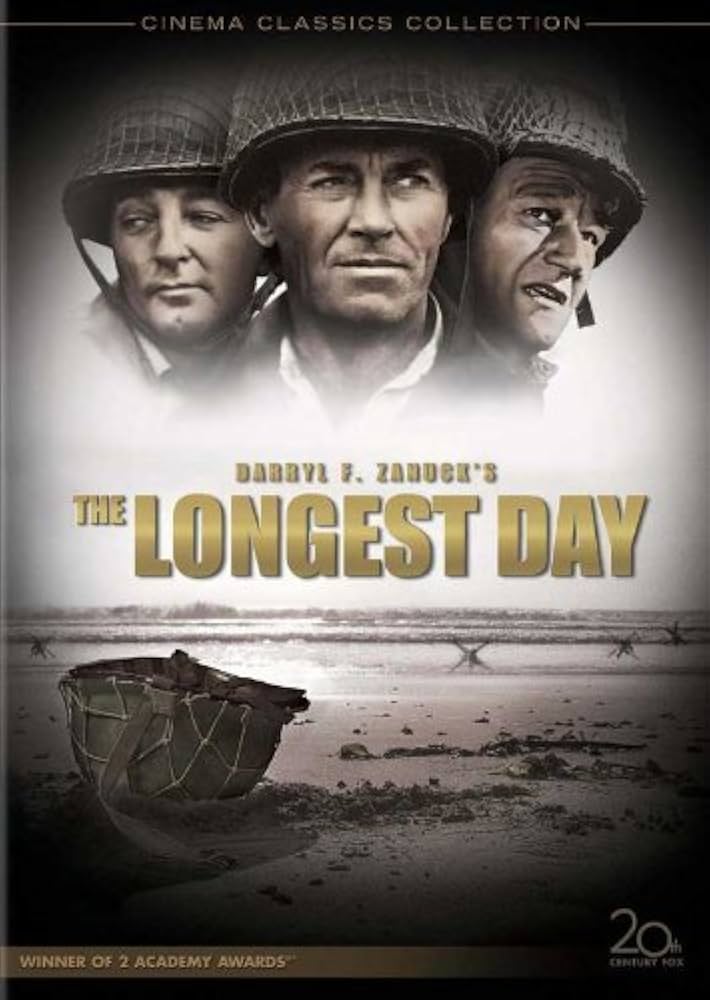
The Longest Day is a 1962 American-British epic war film based on Cornelius Ryan‘s 1959 non-fiction book of the same name[3] about the D-Day landings in Normandy on June 6, 1944. The film was produced by Darryl F. Zanuck for 20th Century-Fox, and is directed by Ken Annakin (British and French exteriors), Andrew Marton (American exteriors), and Bernhard Wicki (German scenes). The screenplay was written by Ryan, with additional material written by Romain Gary, James Jones, David Pursall and Jack Seddon.
The film features a large international ensemble cast that includes John Wayne, Kenneth More, Richard Todd, Robert Mitchum, Richard Burton, Steve Forrest, Sean Connery, Henry Fonda, Red Buttons, Peter Lawford, Eddie Albert, Jeffrey Hunter, Stuart Whitman, Tom Tryon, Rod Steiger, Leo Genn, Gert Fröbe, Irina Demick, Bourvil, Curd Jürgens, George Segal, Robert Wagner, Paul Anka and Arletty. Many of these actors played roles that were essentially cameo appearances. Several cast members had seen action as servicemen during the war, including Albert, Fonda, Genn, More, Steiger and Todd, the latter having been among the first British officers to land in Normandy in Operation Overlord and participate in the assault on Pegasus Bridge.
The filmmakers employed several actual Allied and Axis D-Day participants as consultants, many of whom had their roles re-enacted in the film. These included Günther Blumentritt (a former German general), James M. Gavin (an American general), Frederick Morgan (Deputy Chief of Staff at SHAEF), John Howard (who led the airborne assault on the Pegasus Bridge), Lord Lovat (who commanded the 1st Special Service Brigade), Philippe Kieffer (who led his men in the assault on Ouistreham), Marie-Pierre Kœnig (who commanded the Free French Forces in the invasion), Max Pemsel (a German general), Werner Pluskat (the major who was the first German officer to see the invasion fleet), Josef “Pips” Priller (the hot-headed pilot who was one of the few Luftwaffe pilots to strafe the beaches) and Lucie Rommel (widow of Field Marshal Erwin Rommel).
The Longest Day premiered in France on September 25, 1962, and in the United States on October 4. It received acclaim from critics and was a significant commercial success, becoming the highest-grossing black-and-white movie at the time. At the 35th Academy Awards, the film was nominated for five Oscars, including Best Picture, and won awards for Best Cinematography (Black-and-White) and Best Special Effects.
DOWNLOAD
A BRIDGE TOO FAR
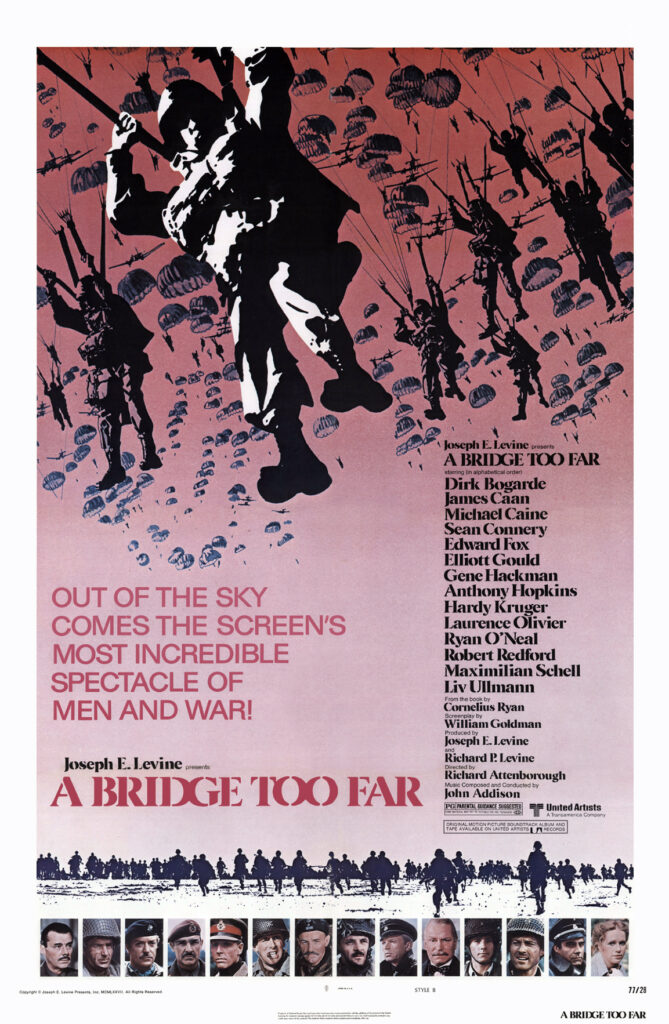
A Bridge Too Far is a 1977 epic war film directed by Richard Attenborough. It depicts Operation Market Garden, a failed Allied operation in the Nazi-occupied Netherlands during World War II; the film’s screenplay, by William Goldman, is based on a book of the same title by historian Cornelius Ryan.[5] It stars an ensemble cast, featuring Dirk Bogarde, James Caan, Michael Caine, Sean Connery, Edward Fox, Elliott Gould, Gene Hackman, Anthony Hopkins, Hardy Krüger, Laurence Olivier, Ryan O’Neal, Robert Redford, Maximilian Schell and Liv Ullmann.
Independently produced by Attenborough and Joseph E. Levine, it was the second film based on a book by Ryan to be adapted for the screen (after The Longest Day (1962)).[6] It was the second film based on the events of Operation Market Garden, following Theirs Is the Glory (1946).[7] A co-production between the United Kingdom and the United States,[8] the film was shot on location in the Netherlands, in many of the real locations where the historical events took place.
Although released to a tepid critical response, A Bridge Too Far received several awards. At the 31st BAFTA Awards it won four out of eight nominated categories, including Best Supporting Actor for Edward Fox and Best Score for John Addison—who himself had served in the British XXX Corps during Market Garden. Attenborough was nominated for Best Direction, and the film was nominated for Best Motion Picture. It was a success at the box office, becoming the sixth-most popular movie of 1977.