JAWS
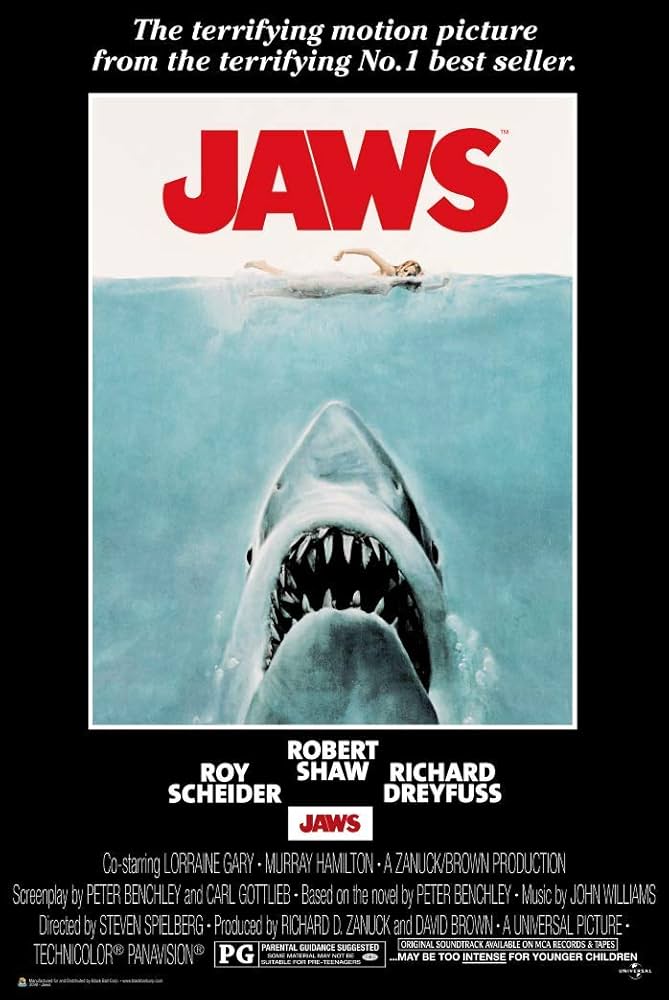
Jaws is a 1975 American thriller film directed by Steven Spielberg, based on the 1974 novel by Peter Benchley. It stars Roy Scheider as police chief Martin Brody, who, with the help of a marine biologist (Richard Dreyfuss) and a professional shark hunter (Robert Shaw), hunts a man-eating great white shark that attacks beachgoers at a New England resort town. Murray Hamilton plays the town’s mayor, and Lorraine Gary portrays Brody’s wife. The screenplay is credited to Benchley, who wrote the first drafts, and actor-writer Carl Gottlieb, who rewrote the script during principal photography.
Shot mostly on location at Martha’s Vineyard in Massachusetts from May to October 1974, Jaws was the first major motion picture to be shot on the ocean and consequently had a troubled production, going over budget and schedule. As the art department’s mechanical sharks often malfunctioned, Spielberg decided to mostly suggest the shark’s presence, employing an ominous and minimalist theme created by composer John Williams to indicate its impending appearances. Spielberg and others have compared this suggestive approach to that of director Alfred Hitchcock. Universal Pictures released the film to over 450 screens, an exceptionally wide release for a major studio picture at the time, accompanied by an extensive marketing campaign with heavy emphasis on television spots and tie-in merchandise.
Regarded as a turning point in motion picture history, Jaws was the prototypical summer blockbuster and won several awards for its music and editing. It was the highest-grossing film in history until the release of Star Wars two years later; both films were pivotal in establishing the modern Hollywood business model, which pursues high box-office returns from action and adventure films with simple high-concept premises, released during the summer in thousands of theaters and advertised heavily. Jaws was followed by three sequels, none of which involved Spielberg or Benchley, as well as many imitative thrillers. In 2001, the Library of Congress selected it for preservation in the United States National Film Registry.
DOWNLOAD
STAND BY ME
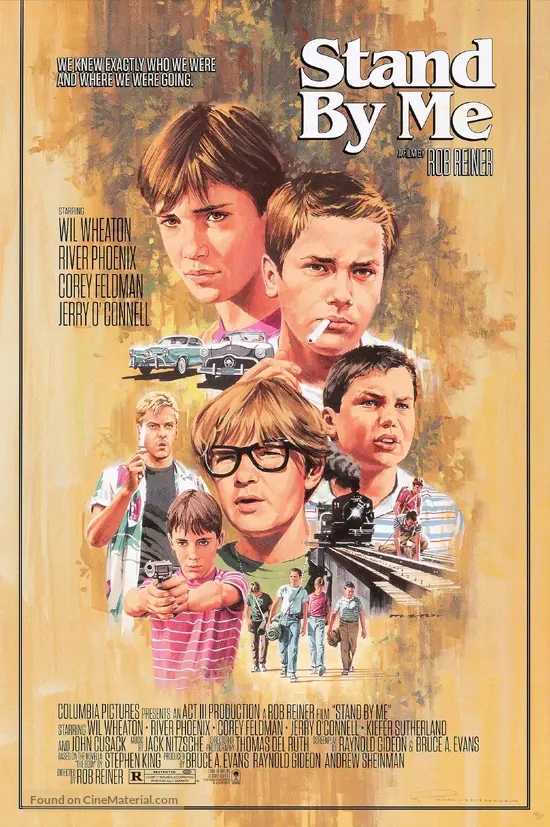
Stand by Me is a 1986 American coming-of-age drama film[5] directed by Rob Reiner. Based on Stephen King‘s 1982 novella The Body, the film is set in the fictional town of Castle Rock, Oregon, in 1959. Stand by Me stars Wil Wheaton, River Phoenix, Corey Feldman, and Jerry O’Connell as four boys who set out on a journey to find the dead body of a missing boy. The film’s title is derived from the 1961 song of the same name by Ben E. King, which plays during the film’s closing credits.
Released in the United States on August 22, 1986, by Columbia Pictures, Stand by Me received positive reviews[6] and was a commercial success. The film was nominated for an Academy Award for Best Adapted Screenplay and for two Golden Globe Awards (Best Drama Motion Picture and Best Director). Rolling Stone has called Stand by Me “a staple of youthful nostalgia” and “the rare movie that necessarily gets better with time”. The film was re-released in theaters on March 27, 2026, to commemorate its 40th anniversary.
DOWNLOAD
DO THE RIGHT THING
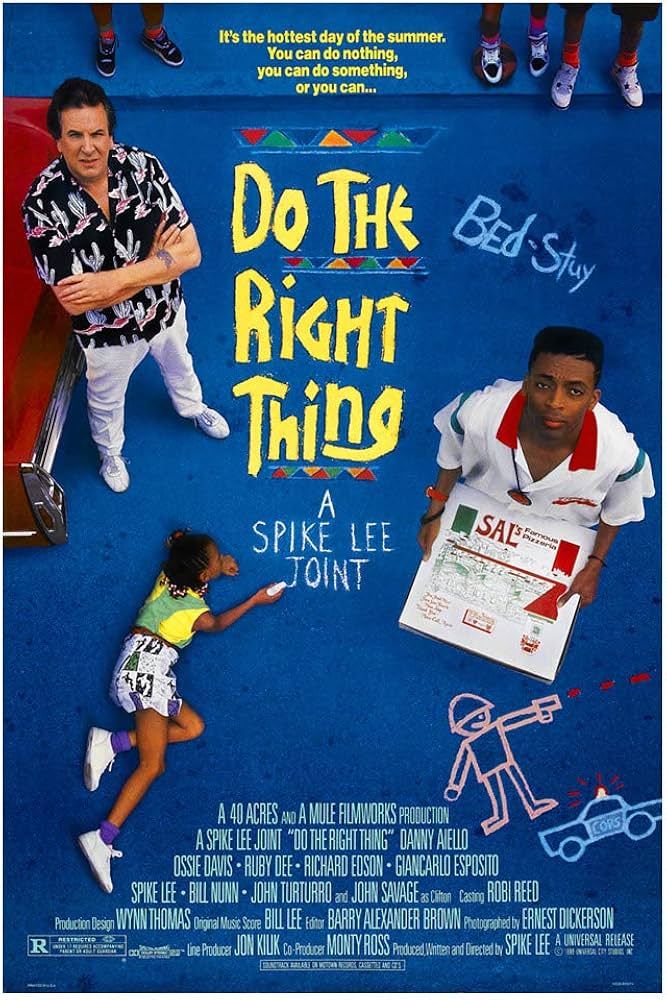
Do the Right Thing is a 1989 American independent comedy-drama hood film produced, written and directed by Spike Lee. It features an ensemble cast that includes Danny Aiello, Ossie Davis, Ruby Dee, Richard Edson, Giancarlo Esposito, Lee, Bill Nunn, John Turturro and John Savage and is the feature film debut of Martin Lawrence and Rosie Perez. The story explores a Brooklyn neighborhood’s simmering racial tension between its African-American residents and the Italian-American owners of a local pizzeria, culminating in tragedy and violence on a hot summer’s day.
Do the Right Thing premiered at the 42nd Cannes Film Festival on May 19, 1989, and was theatrically released in the United States on June 30. It was a major critical and commercial success, grossing $37.3 million worldwide against a production budget of $6.2 million. Blending elements of comedy, drama and social commentary, the film is noted for its vivid color design, stylized cinematography, direct-address monologues and an influential hip-hop-driven soundtrack, prominently featuring Public Enemy‘s “Fight the Power“. Lee’s direction combines heightened realism with theatrical and symbolic techniques to convey the psychological and emotional effects of heat, crowd dynamics and urban life. The film’s ambiguous and controversial conclusion sparked widespread debate upon release regarding the nature of protest, responsibility and moral judgment.
The film earned nominations for Best Original Screenplay and Best Supporting Actor (Aiello) at the 62nd Academy Awards. It has since been widely recognized as one of the most important American films of the late 20th century; in 1999, it was selected for preservation in the United States National Film Registry by the Library of Congress as being “culturally, historically or aesthetically significant”.[4][5] In 2022, the film was ranked the 24th greatest of all time in Sight and Sound magazine’s decennial poll of international critics, programmers, curators, archivists and academics.[6] It has been featured on many other lists of the greatest films of all time by numerous critics.[a
DOWNLOAD
DAZED AND CONFUSED
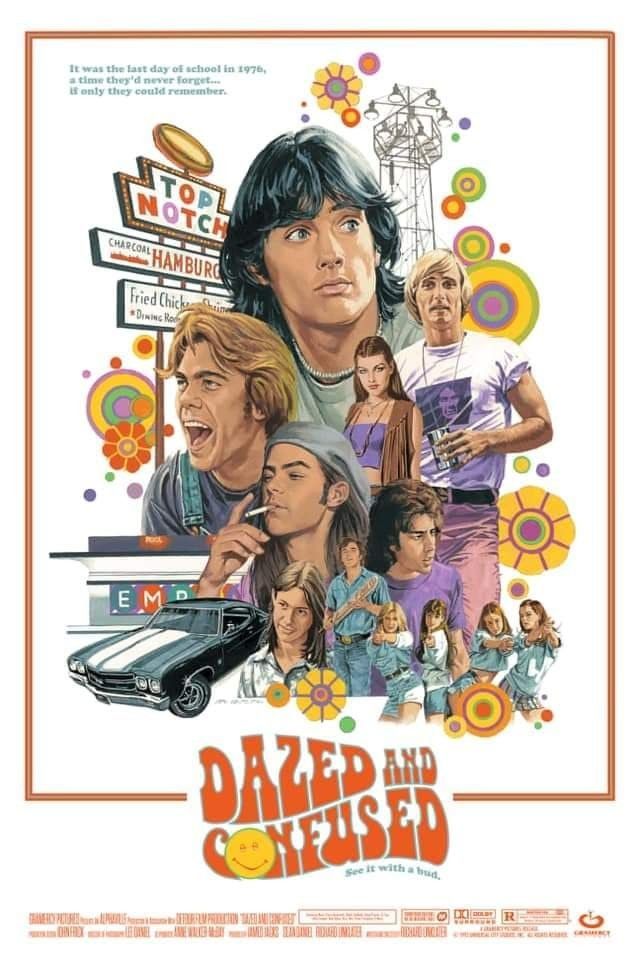
Dazed and Confused is a 1993 American coming-of-age comedy film written and directed by Richard Linklater. The film follows a variety of teenagers on the last day of school in 1976. Although the film was shot in Austin, it was inspired by Linklater’s time growing up in East Texas and no town name is ever given. The film has no single protagonist or central conflict; rather, it follows interconnected plot threads among different social groups and characters, such as rising ninth graders undergoing hazing rituals, a football star’s refusal to sign a clean-living pledge for his coach, and various characters hanging out at a pool hall. The film features a large ensemble cast of actors who would later become stars, including Jason London, Ben Affleck, Matthew McConaughey, Milla Jovovich, Cole Hauser, Parker Posey, Adam Goldberg, Nicky Katt, Joey Lauren Adams, Rory Cochrane, and Anthony Rapp.
Linklater originally planned to make a teen film after his breakout feature Slacker. Slacker caught the attention of Universal Pictures producer Jim Jacks, who secured 6 million dollars for Linklater’s next feature. Linklater drew heavily on his adolescence in Huntsville, Texas, to write the script, lifting the names of several people from his hometown for the characters. Most actors cast for the film were undiscovered talent, including McConaughey, who became the film’s breakout star. Linklater shot the film around Austin, with several members of his crew from Slacker. The actors were encouraged to improvise and develop their own characters, with some writing in extra scenes. Linklater gathered several 1970s rock songs for the soundtrack, which made up a significant portion of the film’s budget. The picture was marketed by Gramercy Pictures as a stoner film, to Linklater’s dismay.
Released on September 24, 1993, Dazed and Confused was a commercial disappointment at the box office, grossing less than $8 million in the United States. The film later found success on the home video market and has since become a cult classic. It ranked third on Entertainment Weekly magazine’s list of the 50 Best High School Movies.[6] The magazine also ranked it 10th on its “Funniest Movies of the Past 25 Years” list.[7] Reviewers have praised the film for its faithful and humanistic depiction of the setting and of high school life.[8][9]
DOWNLOAD
REAR WINDOW
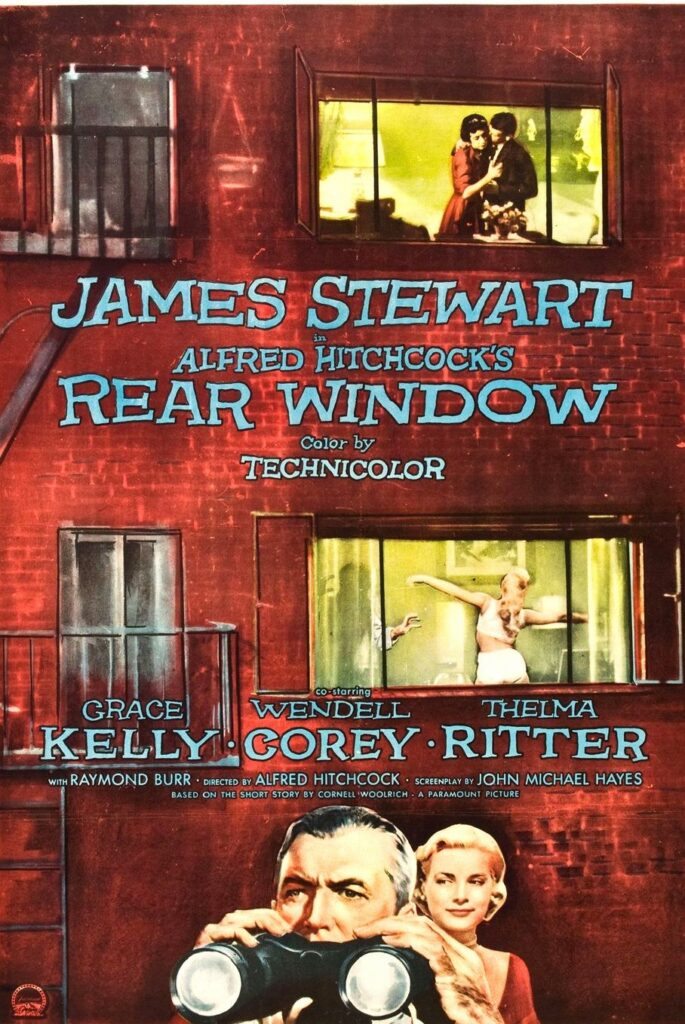
Rear Window is a 1954 American mystery thriller film produced and directed by Alfred Hitchcock and written by John Michael Hayes, based on Cornell Woolrich‘s 1942 short story “It Had to Be Murder“. Originally released by Paramount Pictures, the film stars James Stewart, Grace Kelly, Wendell Corey, Thelma Ritter, and Raymond Burr. It was screened at the 1954 Venice Film Festival in competition for the Golden Lion.
Rear Window is shot almost entirely from within one room and from the point-of-view outside the window. The film was made with a budget of $1 million ($12 million in 2025), and grossed $27 million during its initial release ($324 million in 2025).[6]
Rear Window is considered by many filmgoers, critics, and scholars to be one of Hitchcock’s best films,[7] as well as one of the greatest films ever made. It received four Academy Award nominations, and was ranked number 42 on AFI’s 100 Years…100 Movies list and number 48 on the 10th-anniversary edition, and in 1997 was added to the United States National Film Registry in the Library of Congress as being “culturally, historically, or aesthetically significant.”[8][9]
DOWNLOAD
DOG DAY AFTERNOON
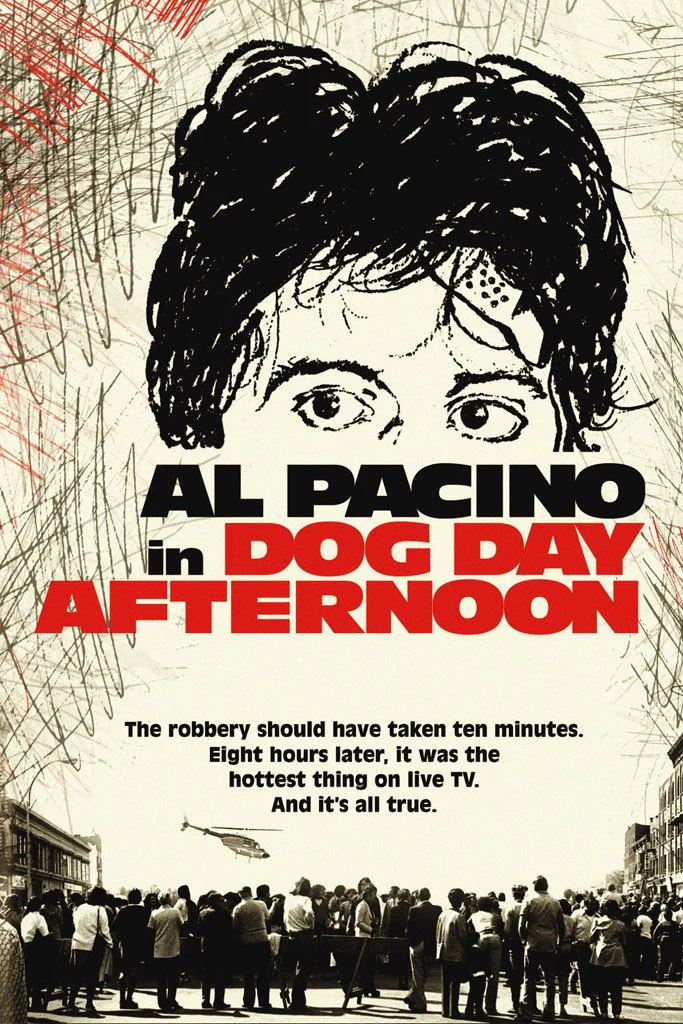
Dog Day Afternoon is a 1975 American biographical crime drama film directed by Sidney Lumet and produced by Martin Bregman and Martin Elfand. The film stars Al Pacino, John Cazale, James Broderick and Charles Durning. The screenplay is written by Frank Pierson and is based on the Life magazine article “The Boys in the Bank” by P. F. Kluge and Thomas Moore. The feature chronicles the 1972 robbery and hostage situation led by John Wojtowicz and Salvatore Naturile at a Chase Manhattan branch in Brooklyn.
Elfand brought the article to Bregman’s attention, who proceeded to negotiate a deal with Warner Bros. Pictures and clear the rights to use the story. Pierson conducted his research and wrote a script that centered on the story of the robbery around Wojtowicz. The cast was selected by Lumet and Pacino, with the latter selecting past co-stars from his off-Broadway plays. Filming took place between September and November 1974, and the production was finished three weeks ahead of schedule.
When theatrically released on September 21, 1975, Dog Day Afternoon was a critical and box-office success. The film was nominated for seven Golden Globe Awards, six BAFTAs (winning Best Actor for Pacino and Best Editing), and six Academy Awards (winning Best Original Screenplay). In 2009, Dog Day Afternoon was deemed “culturally, historically, or aesthetically significant” by the Library of Congress, and was selected for preservation in the National Film Registry.
DOWNLOAD
NATIONAL LAMPOON’S VACATION
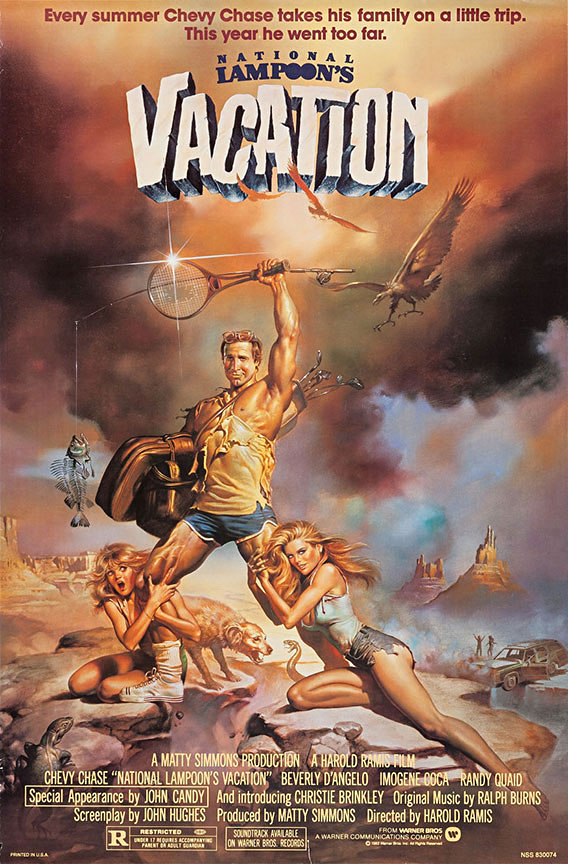
National Lampoon’s Vacation, sometimes referred to as simply Vacation, is a 1983 American comedy road film directed by Harold Ramis and starring Chevy Chase, Beverly D’Angelo, Imogene Coca, Randy Quaid, John Candy, and Christie Brinkley in her acting debut with special appearances by Eddie Bracken, Brian Doyle-Murray, Miriam Flynn, James Keach, Eugene Levy, and Frank McRae. It tells the story of the Griswold family on a cross-country trip to an amusement park and various locations as accidents and mishaps occur along the way. The screenplay was written by John Hughes on the basis of his short story “Vacation ’58”, which appeared in National Lampoon.
National Lampoon’s Vacation was released by Warner Bros. on July 29, 1983. The film was a box-office hit, earning more than $60 million in the U.S. alone with an estimated budget of $15 million.
As a result of its success, five sequels have been produced: European Vacation (1985), Christmas Vacation (1989), Vegas Vacation (1997), Christmas Vacation 2 (2003), and Vacation (2015). In 2000, readers of Total Film voted it the 46th greatest comedy film of all time.[3]
DOWNLOAD
AMERICAN GRAFFITI
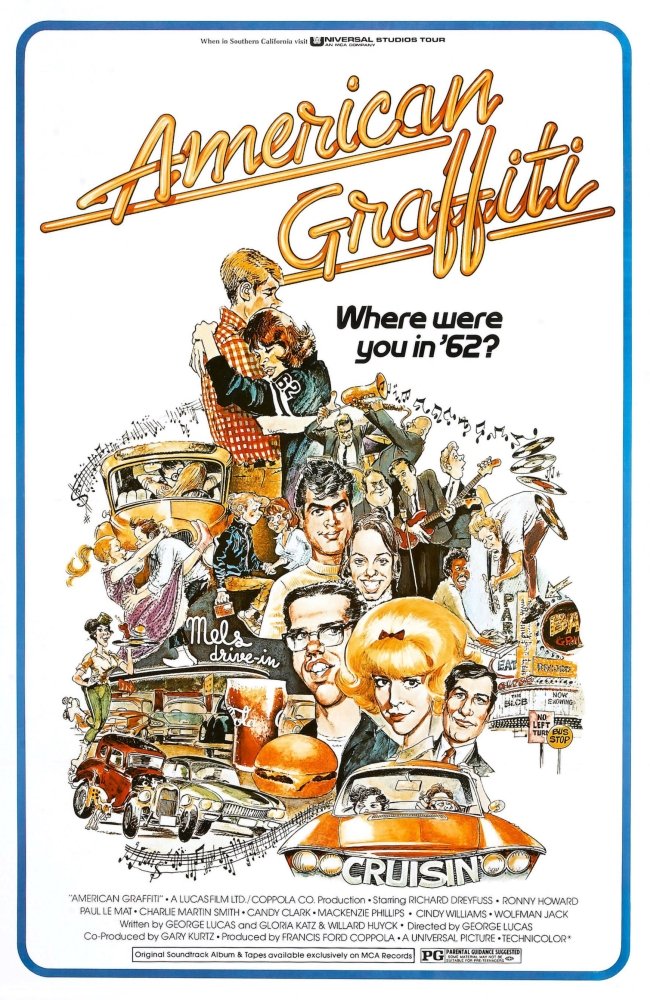
American Graffiti is a 1973 American coming-of-age comedy-drama film directed by George Lucas, produced by Francis Ford Coppola, written by Lucas, Gloria Katz, and Willard Huyck, and starring Richard Dreyfuss, Ron Howard, Paul Le Mat, Charles Martin Smith, Candy Clark, Mackenzie Phillips, Cindy Williams, and Wolfman Jack. Harrison Ford and Bo Hopkins also appear. Set in Modesto, California, in 1962, the film is a study of the cruising and early rock and roll cultures popular among Lucas’ age group at that time. Through a series of vignettes, it tells the story of a group of teenagers and their adventures throughout a single summer night.
While Lucas was working on his first film, THX 1138, Coppola asked him to write a coming-of-age film. The genesis of American Graffiti took place in Modesto in the early 1960s, during Lucas’s teenage years. He was unsuccessful in pitching the concept to financiers and distributors but found favor at Universal Pictures after every other major film studio turned him down. Filming began in San Rafael, California, but the production crew was denied permission to shoot beyond a second day. As a result, production was moved to Petaluma, California.[2][3] It is the first film to be produced by his Lucasfilm production banner.
American Graffiti premiered on August 2, 1973, at the Locarno International Film Festival in Switzerland and was released in the United States on August 11, 1973. Despite low expectations from Universal Pictures, who initially planned to release it as a television film, the film was given a theatrical release after Francis Ford Coppola, fresh off the success of The Godfather, agreed to attach his name as an executive producer. Completed on a modest budget of $777,000 (equivalent to about $6.2 million in 2026), American Graffiti became one of the most profitable films of all time, earning over $200 million in box office and home video revenue.
The film received widespread critical acclaim and was nominated for five Academy Awards, including Best Picture. It is widely credited with launching a wave of 1950s and early 1960s nostalgia in American pop culture, influencing the teen comedy genre and reviving interest in early rock and roll among the baby boomer generation. In 1995, it was selected for preservation in the National Film Registry by the Library of Congress for being “culturally, historically, or aesthetically significant.”
DOWNLOAD
12 ANGRY MEN
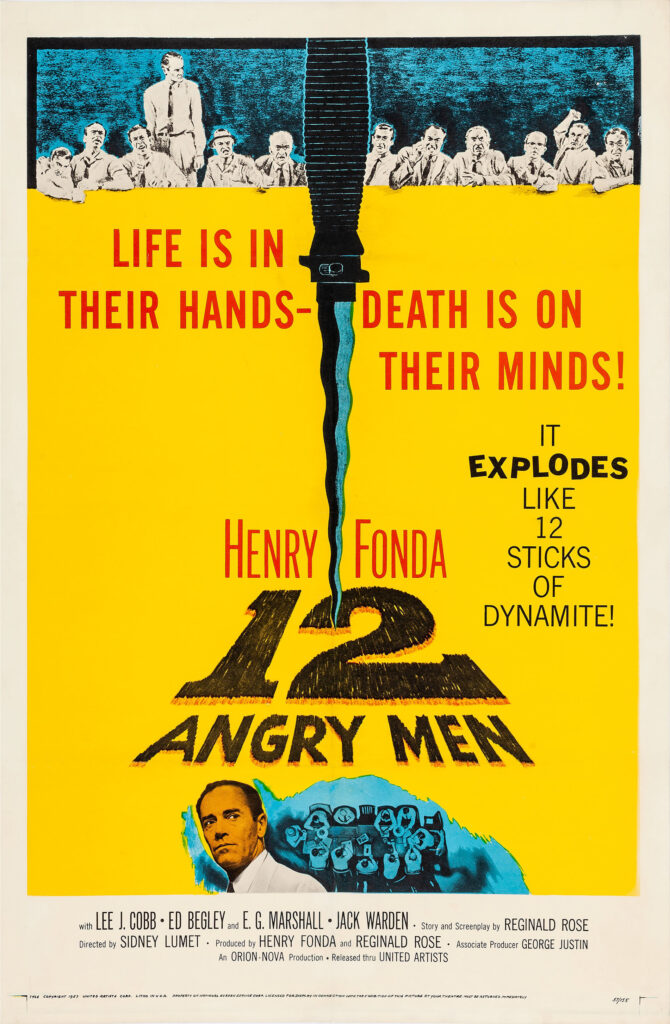
12 Angry Men is a 1957 American legal drama film directed by Sidney Lumet in his feature directorial debut, adapted by Reginald Rose from his 1954 teleplay.[6][7] A critique of the American jury system during the McCarthy era,[8][9] the film tells the story of a jury of twelve men as they deliberate the conviction or acquittal of a teenager charged with murder on the basis of reasonable doubt; disagreement and conflict among the jurors forces them to question their morals and values. It stars an ensemble cast, featuring Henry Fonda (who also produced the film with Rose), Lee J. Cobb, Ed Begley, E. G. Marshall, and Jack Warden.
An independent production[10][11] distributed by United Artists, 12 Angry Men received acclaim from critics, despite a lukewarm box-office performance. At the 30th Academy Awards, it was nominated for Best Picture, Best Director and Best Screenplay. It is regarded by many as one of the greatest films ever made.
In 2007, it was selected for preservation in the United States National Film Registry by the Library of Congress as being “culturally, historically or aesthetically significant”.[12] Additionally, it was selected as the second-best courtroom drama ever (after 1962’s To Kill a Mockingbird) by the American Film Institute for their AFI’s 10 Top 10 list.[13]
DOWNLOAD
(500) DAYS OF SUMMER
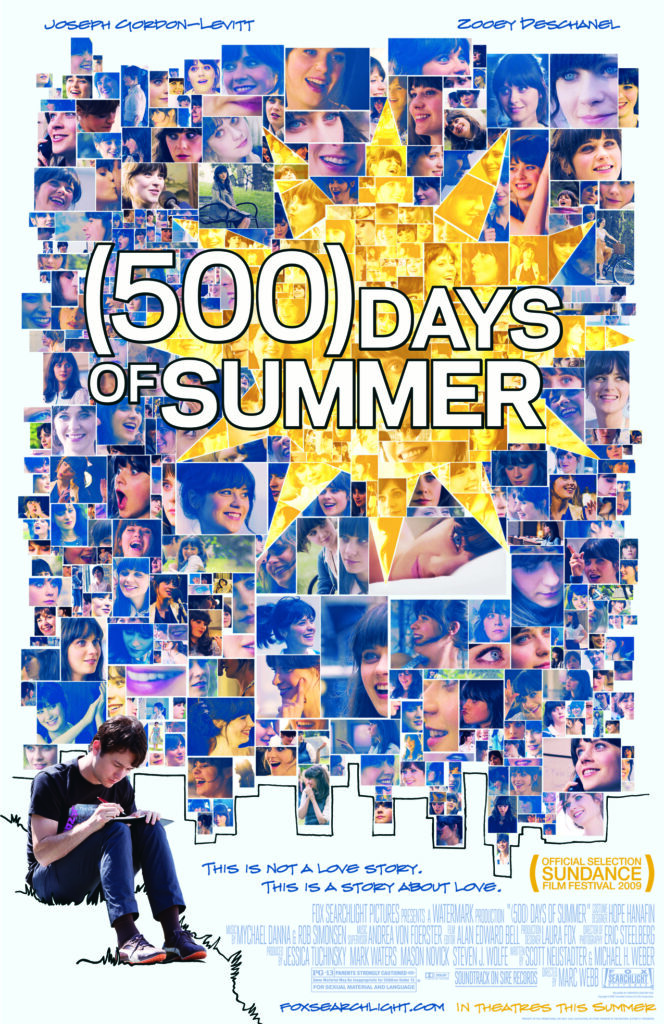
(500) Days of Summer is a 2009 American romantic comedy-drama film directed by Marc Webb in his feature directorial debut,[3] written by Scott Neustadter and Michael H. Weber, and produced by Mark Waters. The film stars Joseph Gordon-Levitt and Zooey Deschanel as Tom and Summer respectively, and in a nonlinear narrative structure, Tom chronicles the story of his relationship with Summer.
As an independent production, the film was picked up for distribution by Fox Searchlight Pictures and premiered at the 25th Sundance Film Festival. It received positive critical reviews and became a successful “sleeper hit“, earning $60.7 million in worldwide returns, far exceeding its $7.5 million budget. Many critics lauded the film as one of the best from 2009 and drew comparisons to other acclaimed films such as Annie Hall (1977) and High Fidelity (2000).[4][5][6] The movie is considered a cult classic.[7][8]
The film received Best Original Screenplay and Best Screenplay awards at the 14th Satellite Awards and 25th Independent Spirit Awards, respectively, as well as two nominations at the 67th Golden Globe Awards: Best Motion Picture – Musical or Comedy and Best Actor – Musical or Comedy (Gordon-Levitt).[9]